Evelyn Lee
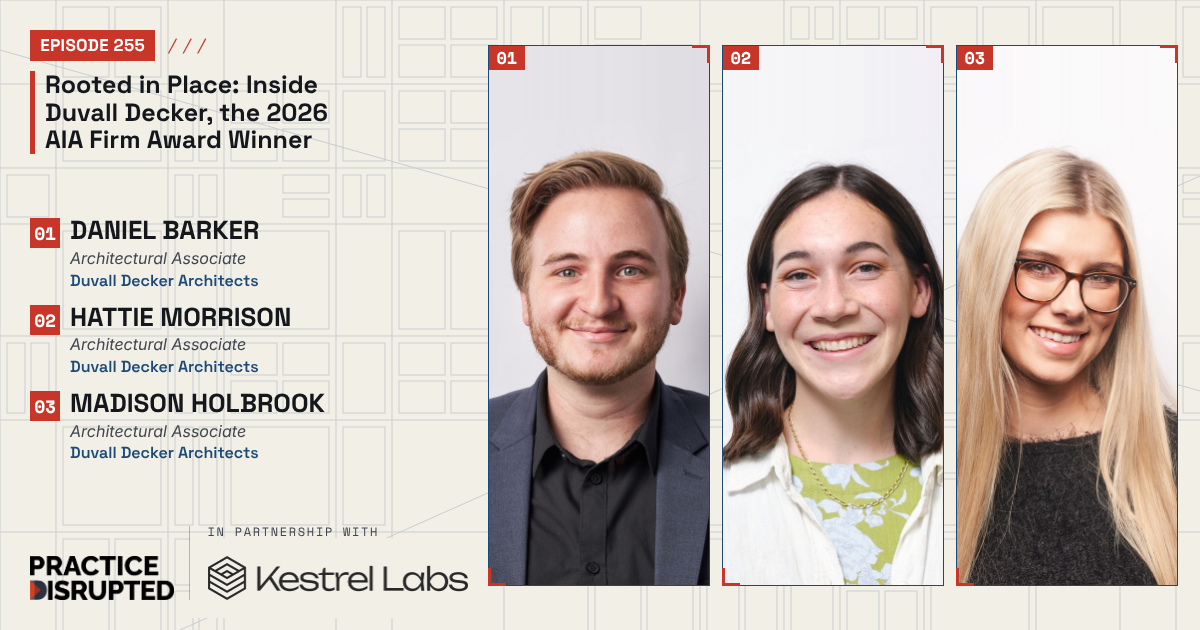
Hello Reader, This week was my first Trimble Dimensions, in Las Vegas, supporting their 0-60 finalists. I'm an introvert, and a conference where I know a handful of people takes deliberate effort. Ten questions I use to start those conversations are in Friday's LinkedIn post. FMI Corporation, the management consulting and investment banking firm that serves the construction industry, puts US construction spending down 3.4 percent next year, to 2.167 trillion dollars, in its fourth quarter outlook. When a number like that lands, the reflex is to go find a growing market. It's hard for a firm to transfer into one it has never worked in. My guests this week are Daniel Barker, Hattie Morrison, and Madison Holbrook, three architectural associates at Duvall Decker in Jackson, Mississippi, this year's AIA Architecture Firm Award winner. I made the call announcing that award during my presidency, so I knew the firm well, not the work. I hadn't fully grasped what the practice looks like from anywhere other than the top. Duvall Decker didn't go find a new market. It went further into the one it already had. The firm runs Dunn Management, which handles building and facilities maintenance, and Elden Development, which does development consulting. Those aren't side businesses bolted on to cover a slow year. They come out of staying involved with a building after it opens, which keeps the firm answerable to its client in a way a closeout letter doesn't. The buildings were already there. So were the clients. Duvall Decker built revenue around both. The firm also wrote a book of 53 things it had learned, which it calls its Foundations. What surprised me was how much those Foundations encompass the firm's values. The three of them describe it as what shapes how they work together and how they decide, and each of them, four and five years in, can tell you how that office thinks. In most firms the answer to how we do this here sits with whoever has been there longest, which means it goes home at five and eventually retires. The Adaptability Read scores a firm on four channels: feedback, failure, time, and tools. Failure, which is how a firm handles it when something goes wrong, comes out lowest most often. Writing down what a firm has learned is one way to answer that. The firms I watch come through a down year in decent shape are rarely the ones that found a new market in November. They're the ones who already knew what they had. So here's my question. If every new market closed to you tomorrow, what does your firm already own that it has never once sold?
I read every reply and I answer them, so feel free to write any time. Keep learning and growing,
P.S. I'm teaching four free Claude workshops for architecture firms in December. The dates are below. This issue is brought to you by our partner Kestrel Labs.
Kestrel runs code checking inside Revit against licensed ICC content, and it keeps a record of every check and every dismissal, so the reasoning behind a call is still there months later when somebody asks why. /// practice disrupted ///🎧 EP255: Rooted in Place: Inside Duvall Decker, the 2026 AIA Firm Award Winner
Presented in partnership with Kestrel Labs. Daniel Barker, Hattie Morrison, and Madison Holbrook on what the Firm Award year looks like from inside the studio: regional work, 53 written Foundations, and a practice that stays with a building after it opens.
/// the signal ///Four threads I've been following this week. AIA Architect profiled RESET on November 2, a Pacific Palisades rebuilding program that bundles pre-approved, fire-resistant home designs with insurance, permitting, engineering, and off-site manufacturing. Geoff Hackett, CEO of Builders Workshop, says that once the homes could be insured, the odds of getting them built went way up. David Montalba of Montalba Architects puts the architect's job inside that plainly: repeating a design has to make the work more efficient without costing quality. Think of the last project of yours that stalled. Was it the design that stopped it, or something the design was waiting on? Eric Cesal, writing in Common Edge, satirizes the camps AI has created inside architecture offices, from a Hype Department to a Department of Professional Self-Destruction. His argument is that the firms that do well will be the ones whose people turn that friction into something useful, not the ones with the most advanced tools. Most offices already have both camps. Who in yours has been asked, in a meeting, to say what they're worried about? Kelly Alvarez Doran, writing in Common Edge, argues that cities should test whether a street actually needs the width it has been given before applying the standard. It reads as a planning argument and I take it as a practice one. Street width is land nobody can build on, and the dimension gets carried forward because it is the standard, not because anyone checked it against this street. Most offices have a few numbers like that sitting in their own details. And Eleni Stefania Kalapoda, writing as a juror on Archinect, argues that an architecture award for women should be built to make itself unnecessary. I like that test and it is harder than it sounds, because it asks what would have to become true for the program to end rather than how the program is doing. Any firm running a parallel program for representation can put the same question to it, and most of us have never set that date. Want more where this came from? I track all of it week to week, and Lab members get the full list every Friday, with sources and one line on what each item means for a practice. /// the handoff /// - something you can do on MondayCall one client after the building opens.1. Pick a project that finished six to eighteen months ago, one where you still have the owner's contact. 2. Call them. Don't email. Say you're checking in on how the building is working, and that you're not selling anything. 3. Ask three questions. What has stopped working or needed fixing? What did your staff have to figure out that nobody explained at turnover? What would you want the next architect to know? 4. Write down what they say in their words, in one document with the project name and the date. 5. Take the answer you heard twice, or the one that surprised you, to whoever is drawing the next building of that type, and ask whether it changes anything on a set going out this month. /// up and coming ///The next four on the calendar: Business Operations for Architecture Firms: A Hands-on AI Workshop. Friday, December 4, 10:00 to 11:30am Pacific, virtual. register here Business Operations for Architecture Firms: A Hands-on AI Workshop. Monday, December 7, 10:00 to 11:30am Pacific, virtual. register here Business Operations for Architecture Firms: A Hands-on AI Workshop. Tuesday, December 15, 10:00 to 11:30am Pacific, virtual. register here Business Operations for Architecture Firms: A Hands-on AI Workshop. Wednesday, December 16, 10:00 to 11:30am Pacific, virtual. register here The full list is at evelynlee.com/speaking. I'm booking 2027 now. If you have a date in mind, reply to this email. | |||||||||||||||||||||||||||||||||||||||||||||||||