Evelyn Lee
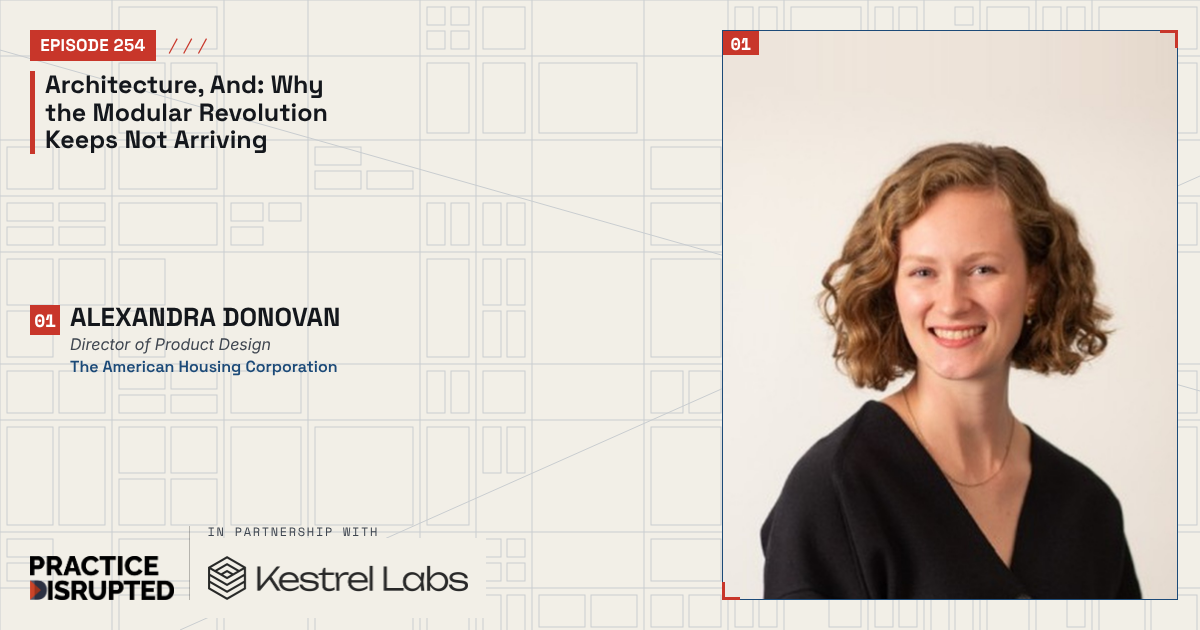
Hello Reader, This was my first normal week in a while, and it was really good to get back to a daily routine. Some friends who have had tremendous growth on social have encouraged me to do more videos, so I've been posting them on Instagram and LinkedIn. It's been difficult to put myself out there in something that goes beyond writing, which I've been doing since 2005. If you've been seeing them, please let me know what you think. Your feedback would mean a lot. Social, in general, is a funny thing. You can only hold somebody's attention for so long, and some people base everything on the one thing they see. A project works the same way. The next team works from whatever was handed to them, and nothing else. I spent ten years on the owner's side of the table. The projects that went sideways on me didn't go sideways in design. They went sideways the week the work changed hands, when whatever the first team knew and never wrote down got rediscovered at somebody else's expense. It's what the drawings don't say: why a detail was drawn that way, what the client already said no to, which consultant needs a phone call instead of an email. My guest this week, Alexandra Donovan, worked on stacking a three-story modular building in Fort Greene in a single Saturday. Then the on-site completion work ran well past its dates. When she interviewed the team afterward, she found death by a thousand cuts: small technical problems, and a factory that hadn't handed off cleanly to the people finishing the job. Her read is that we already have much of the technology, and that we still have to remember the human side, how teams talk to each other, in drawings and out loud. Your firm has that same seam, several times a project. Schematic design to design development. Your set to a consultant's. The project manager who leaves in month nine. Each one is a place where somebody's knowledge stops and somebody else starts guessing, and none of them appears on a fee schedule. Alexandra also described buildings treated as products, with design libraries and post-occupancy data coming back to the people who drew them. That only holds if the handoffs hold. A product you cannot hand off is a prototype. So here's my question. Which handoff inside your own firm is somebody quietly paying for right now?
I read every reply and I answer them, so feel free to write any time. Keep learning and growing,
P.S. I'm teaching four free Claude workshops for architecture firms in December. The dates are below. This issue is brought to you by our partner Kestrel Labs.
Kestrel runs inside Revit and keeps a record of every code issue it raises and every one somebody dismisses, with the reason attached, so a review leaves a trail rather than a memory. Their guide, Compliance Isn't a Milestone, makes the case for checking as you design instead of saving it for the end of a phase. /// practice disrupted ///🎧 EP254: Architecture, And: why the modular revolution keeps not arriving
/// the signal ///Three threads I've been following this week. The Federal Open Market Committee held the federal funds target range at 3.75 to 4.00 percent at its October 28 meeting, on a 10 to 2 vote, and both dissenters wanted a hike (Federal Reserve). What I would do with that is look at my own proposals rather than my forecast. A phased fee that quietly assumes a better spring is a price set on a rate cut, and the only two people in that room who broke ranks broke the other way. A client asking whether to wait deserves a number for what waiting costs them, which is a question you can answer, rather than your view on the Fed, which you can't. On October 27, Martyn Day reported that Autodesk isn't giving up on charging per seat. It's adding charges on top of the seat for computer processing and data access, while telling customers that design and documentation will move from Revit into Forma over time (AEC Magazine). Most firms budget software as one number per person per year. Once you're paying by use, that number moves with how much a project uses, and the first time you'll see it is on the invoice. If you own a firm, ask whoever runs your software what you'd pay if your AI use doubled next year, and what your next Revit renewal commits you to before Forma can do the job. On October 26, CPA Practice Advisor reported findings from the Accounting MOVE Project: 65 percent of accounting firms said caregiving affected someone's career progression in the past year, 47 percent saw people slow down or put off promotion or partnership, and only 24 percent have a formal, written alternative path to partnership (CPA Practice Advisor). None of the firms surveyed had put a cost on the turnover. Architecture firms run on the same partnership track, and I'd guess most of us have never counted this either. If you own a firm, look at who has quietly stepped back from the leadership track in the last two years, and ask whether your ownership plan has a path for them that isn't all or nothing. Want more where this came from? I track all of it week to week, and Lab members get the full list every Friday, with sources and one line on what each item means for a practice. /// the handoff /// - something you can do on MondayOne question, asked at the receiving endTwenty minutes this week, and one question. 1. Pick the most recent handoff inside your own office that cost somebody a week. A phase change, a project moved to a new manager, a consultant set coming back, a set going out to bid. 2. Find the person who received it, not the person who sent it. 3. Ask one question: what did you have to work out for yourself that somebody here already knew? 4. Write the answers down in their words, and stop at five. 5. Pick the one that would have been cheapest to write down in advance, and add it to whatever the sending side already produces, a transmittal, a phase checklist, a kickoff agenda. 6. Put the same question on your calendar for the next handoff of that kind, and ask whoever receives that one. /// up and coming ///Going to Trimble Dimension in Las Vegas this week? So am I. Come find me and say hello. In December, I'm running a free 90-minute Claude workshop for architecture firms: half on getting real work out of Claude and frontier models, half hands-on, starting with meeting notes into a client follow-up email and a proposal section drafted from one you've already sent. Each session starts at 10:00 AM PT on Zoom, and eligible attendees get a free month of Claude Max. Pick one date; they all cover the same material, and registration closes two working days before each session. Register here: Friday, December 4 · Monday, December 7 · Tuesday, December 15 · Wednesday, December 16 See everything coming up at practiceofarchitecture.com/events. Booking for 2027? Reply to this email and let's find a date. |