Hello Reader,
I handed off the AIA presidency at the end of last year, and I'm still working out how to describe what the year actually taught me. Most of it I didn't learn during the year. I learned it in a decade of committee seats and chapter boards, in rooms where getting something wrong cost me an afternoon.
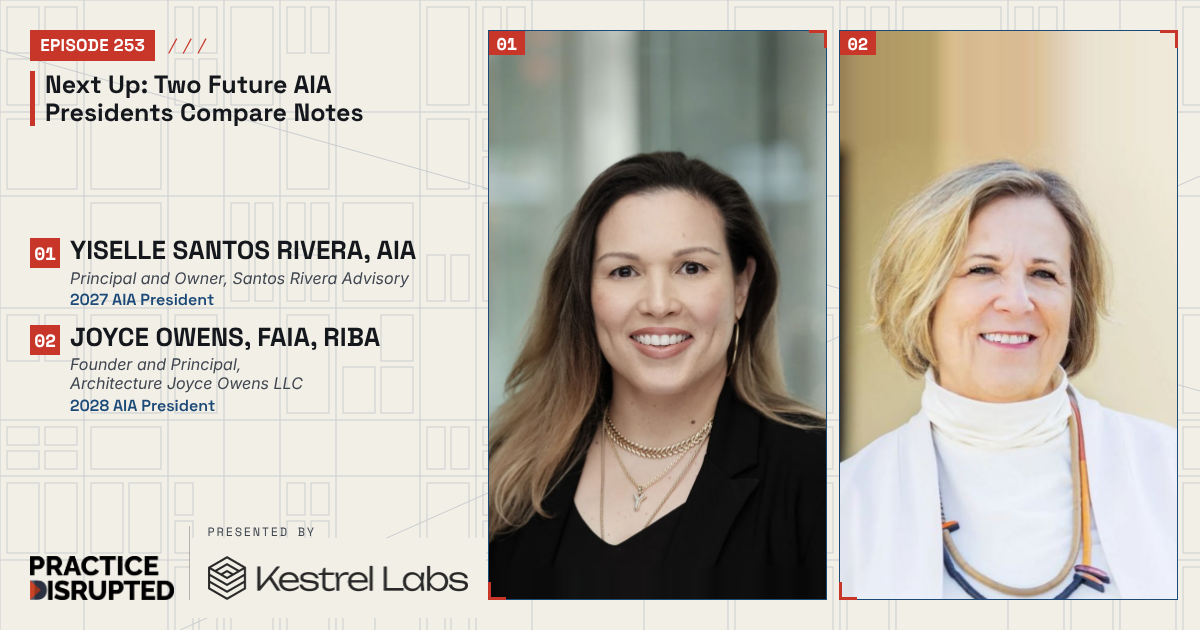
My guests this week are Yiselle Santos Rivera and Joyce Owens, who take the presidency in 2027 and 2028. Neither of them walked a straight line into architecture. Yiselle came through genetics and theology. Joyce left veterinary studies and found the profession through a drafting course. Neither one arrived at a national campaign because somebody identified her early as a future president. They kept showing up where the stakes were low, and the rooms got bigger. Joyce's candidacy started with a visit to say hello to Yiselle that turned into peers telling her to run.
Yiselle put it this way: be present, ask for forgiveness, not for permission.
Which is easy advice to give and almost impossible to take in an office where there is nowhere safe to be present. Most of the firms I work with will tell me they have a leadership problem, meaning nobody under the founders is ready to run anything. Then I ask where somebody in that office would go to practice leading, and the answer is usually nowhere. We hand people leadership the first time it counts: a difficult client, a project in trouble, a partner who just left. Then we read the result as a verdict on whether they have it.
The institute gave me somewhere to be bad at it first. The firms that have an equivalent built it deliberately. A small internal effort with a real budget, a real deadline, and consequences the firm can absorb tells you who steps forward, and it's a cheaper way to learn who isn't ready yet than finding out on your largest project.
I'm not saying volunteer service is the route for everyone. Plenty of people who run firms well have never sat on a board. But something has to do that job, and in most offices nothing does.
So here's my question. Where in your office can somebody lead something badly and have it be survivable?
I read every reply and I answer them, so feel free to write any time.
Keep learning and growing,
|
|
Evelyn Lee, FAIA | NOMA
Founder, Practice of Architecture
Host, Practice Disrupted & Fractional COO
|
This issue is brought to you by our partner Kestrel Labs.
Kestrel checks your Revit model against the code your jurisdiction has actually adopted, working from licensed ICC content, so the same model returns the same answer rather than a probable one. Their guide, Compliance Isn't a Milestone, argues for running code review alongside the design instead of saving it for the end of a phase.
get the guide
/// practice disrupted ///
🎧 EP253: Next Up, two future AIA presidents compare notes
|
|
Presented in partnership with Kestrel Labs. Yiselle Santos Rivera, who becomes AIA President in 2027, and Joyce Owens, who follows her in 2028, on the paths that got them there: genetics and theology in one case, abandoned veterinary studies and a drafting course in the other. They talk about what national leadership actually demands day to day, the distance between a campaign platform and running an institute, and why they both tell emerging professionals to take up space now rather than wait to be asked.
|
/// the signal ///
Three threads I've been following this week.
On October 21, Integris Health signed a definitive agreement to join Risant Health, the nonprofit Kaiser Permanente set up to acquire and hold health systems, as its corporate parent, pending regulatory approval (Becker's Hospital Review). The structure is the part worth watching if you do healthcare work. Local operations stay local, and capital planning moves up to the parent. That means the person who decides whether your project gets funded, and the standards it gets designed to, may now sit at an organization nobody in your office has ever met. The relationship you spent fifteen years building is with the operator, not the owner of the capital.
Beatriz Ramo argued in Common Edge on October 22 that redesigning the floor plan, rather than only building more units, could cut the number of new homes needed by around 40 percent (Common Edge). The 40 percent is her own figure from her own practice's work, not an independently sourced one, and I would want to see the arithmetic before repeating it. What I like is the move she is making. The housing conversation has been about entitlement and financing for a decade, with design treated as whatever happens after both are settled, and architects have mostly watched it from outside. Arguing that plan efficiency is itself a supply lever is a way back into the room.
CPL announced on October 21 that it had acquired Bailey Edward, an Illinois architecture and engineering firm, its first move into that state (CPL). I keep thinking about this from the side nobody writes about, which is the firms that competed against Bailey Edward last month. One of your competitors just acquired a balance sheet, a wider service list, and a recruiting pitch it did not have in September, and it did not hire a single person to get them. If you are bidding against a newly acquired firm, you are not bidding against the firm you knew.
Want more where this came from? I track all of it week to week, and Lab members get the full list every Friday, with sources and one line on what each item means for a practice.
more about the Lab
/// the handoff /// - something you can do on Monday
One thing somebody else runs
An hour this week, and one conversation.
1. List everything on your plate this month that no client will ever see. The tool evaluation, the holiday schedule, the recruiting push, the office insurance renewal, the thing you keep moving to next week.
2. Pick the one you would be least bothered to see done differently than you would do it.
3. Write down three things and nothing else: what finished looks like, what it is allowed to spend, and the date it is due.
4. Hand it to one person who does not currently run anything, and tell them which decisions are theirs and which still come to you.
5. Put one thirty minute review on the calendar for the due date, and put nothing in between.
6. Tell them in that first conversation what happens if it goes badly, so they are not guessing at it for six weeks.
/// up and coming ///
The next one on the calendar:
Your Firm Is the Project, workshop, The Venetian, Las Vegas, November 9.
If you'll be there, come find me and say hello.
The full list is at evelynlee.com/speaking.
Booking for 2027? Reply to this email and let's find a date.