Hello Reader,
Thursday I was at the AIA East Bay Design Awards celebration of the winners. I juried the awards a while back, so I already knew the work. A jury sees finished projects. You get drawings, photographs, a written narrative, and a building that either holds together or it doesn't. What a jury never sees is everything that fell out of each project on its way to becoming that building.
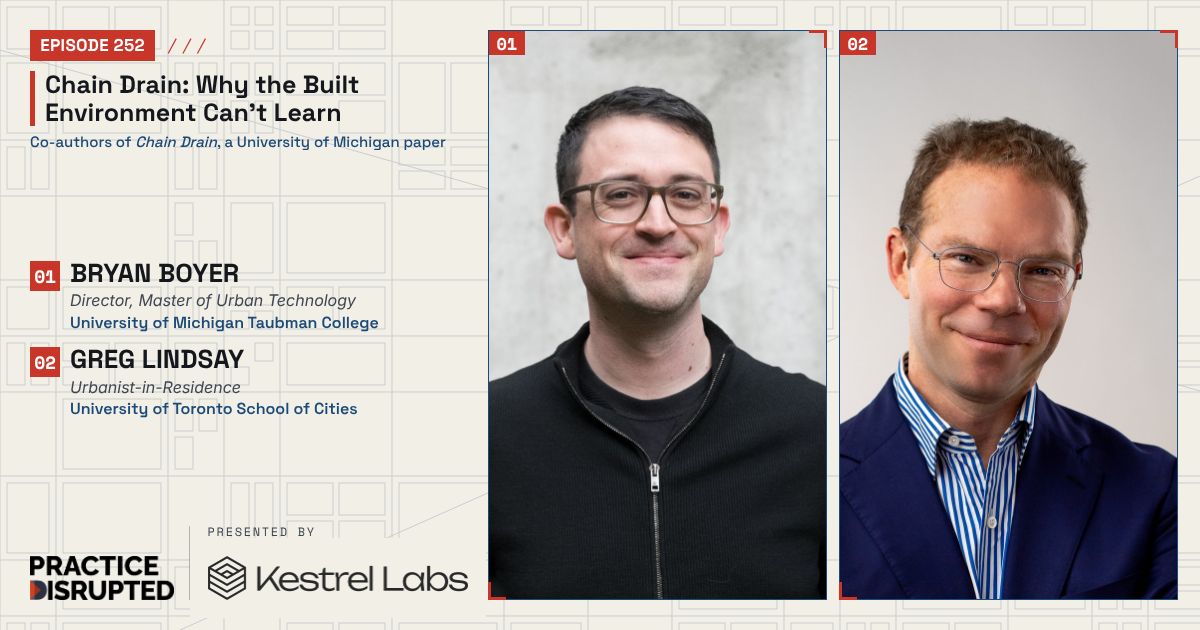
My guest this week, Bryan Boyer, wrote a paper at Michigan with Greg Lindsay called Chain Drain. Their argument is that fifty years of falling productivity in the built environment didn't happen inside firms. It happened between them. Value and intelligence leak out at the handoffs, owner to designer, designer to contractor, contractor to whoever runs the building for the next forty years. Every pass loses something, and nobody owns the losses, because nobody owns the chain.
That lands hard, because nearly everything a firm does to improve itself is aimed inside its own four walls. We standardize details. We buy software. We write QA procedures. Now we're adding AI on top of all of it. Bryan called AI a microwave, which I keep repeating: it makes the existing process faster without anyone asking whether the process was right.
We work on the inside because the inside is the only part we control. That's honest, and it's also why the same losses keep repeating. A detail gets drawn a particular way for a reason your team argued about for two weeks, and when the set leaves your office the reason doesn't go with it. A building opens, and the one thing you'd most want to know, whether the decision worked, never comes back.
Boyer and Lindsay put the accountability with the asset owner, since the owner is the one holding the thing long enough to care how it performs. I think they're right about that, and I don't think it lets a firm off the hook, because an owner can only hold you to what you actually handed over.
So here's my question. What does your firm know about your last finished building that the people running it now have no way to find out?
I read every reply and I answer them, so feel free to write any time.
Keep learning and growing,
|
|
Evelyn Lee, FAIA | NOMA
Founder, Practice of Architecture
Host, Practice Disrupted & Fractional COO
|
This issue is brought to you by our partner Kestrel Labs.
Kestrel runs code checks inside your Revit model, against the code your jurisdiction actually adopted. Their guide, Compliance Isn't a Milestone, argues for re-checking every time the design moves rather than once at the end of a phase, while a change is still cheap to make.
get the guide
/// practice disrupted ///
🎧 EP252: Chain Drain, why the built environment can't learn
|
|
Presented in partnership with Kestrel Labs. Bryan Boyer and Greg Lindsay on their Michigan paper, which argues that the productivity losses in the built environment sit at the handoffs between parties rather than inside any one firm. They talk about why AI speeds up the existing process without touching the strategy, where accountability actually lands, and four scenarios for what practice could look like on the other side of it.
|
/// the signal ///
Three threads I've been following this week.
The Federal Reserve published its October Beige Book on the 14th, and the construction picture in it splits down the middle. Nonresidential work is being carried by data center and defense projects. Residential is weakening, and lending standards tightened again (Federal Reserve). The healthy half of that market buys differently. A data center client and an appropriations-funded client don't run a selection the way a developer does, and every firm I know who got in front of them got there through somebody they already knew rather than through a portfolio. If your pipeline is thinning, the real question isn't whether to chase the growth. It's whether you know anyone on that side of the split.
Digits, an accounting software company, announced on October 13 that its AI agents can now write to the general ledger rather than only read it: create a transaction, update a bill, change the chart of accounts (CPA Practice Advisor). The guardrail is that a closed period locks, and an agent's proposed change to a locked period goes into a queue for a person to approve or reject. All of that is the company's own description of its product, and the customer quoted saying the work ran about four times faster is reporting on itself. The figures aren't what caught me. Somebody in another licensed profession has now written down, in software, exactly where the machine stops and a person signs. I don't know anyone in ours who has written that down for a drawing set.
The AIA published a guide on October 14 called Creating a Better World Together, on financing and building regenerative design, with six case studies and five pillars behind it (AIA). The pillars are the institute's own framing, and frameworks are easy to come by. What I'd actually use it for is narrower than that. A public client sitting in a council meeting needs a published standard to point at, and now there's one with the institute's name on it.
Want more where this came from? I track all of it week to week, and Lab members get the full list every Friday, with sources and one line on what each item means for a practice.
more about the Lab
/// the handoff /// - something you can do on Monday
What went with the set
Twenty minutes this week, and one email to a past client.
1. Pick a project your office finished between one and three years ago, one that's been occupied long enough for somebody to have formed an opinion about it.
2. Find the single design decision on it your team argued about the longest.
3. Write down, in one sentence, what you'd want to know about how that decision is holding up now.
4. Send that one question to your client contact, or to whoever has been in the building since it opened: the facilities lead, the property manager, the contractor's superintendent.
5. End the email by asking what's coming up for them, whether that's another building, a renovation, or a repair on this one.
6. Put whatever comes back into the project folder, under a file name somebody looking for it would actually find.
/// up and coming ///
The next two on the calendar:
AIA New Mexico, lecture, George Pearl Hall, University of New Mexico School of Architecture and Planning, Albuquerque, October 26.
Your Firm Is the Project, workshop, The Venetian, Las Vegas, November 9.
If you'll be at either of these, come find me and say hello.
The full list is at evelynlee.com/speaking.
Booking for 2027? Reply to this email and let's find a date.