Evelyn Lee
Hello Reader,
This past week I was in Chicago to serve on the jury for AISC's IDEAS awards. Before the judging started, I walked the river in unseasonably warm November weather.
I fell in love with Chicago's architecture while I was working on my BArch at Drury University. Every once in a while we need a reminder of what we love about architecture and about being architects, and Chicago consistently does that for me. I came home reminded of the stunning things people are capable of when they bring an idea to life.
Walk that river and you pass buildings at every stage of their lives, some a century old and some only a few years in.
I spent ten years on the owner's side of the table, the side that hires architects, a lot of it in workplace. On commercial interiors we designed for the length of our lease, and we rarely planned on being in a space beyond 10 to 15 years.
My guest this week is Sydney Mainster, Vice President of Sustainability and Design Management at The Durst Organization, which she describes as a privately held, family-run developer, owner, and operator in New York. Durst doesn't hand a finished building to somebody else. It keeps it, runs it, and pays for it for decades.
That puts Sydney where a design decision gets its second life. A design team's work is judged once, at closeout, by people who sat in the meetings. The decision itself gets judged for the next thirty years by somebody the firm has never met: whoever cleans that surface, replaces that fixture, and explains to a tenant why that room is cold.
I also asked her about the license, and whether it still means what it meant when she was in a studio. She was honest about it in a way I'm still thinking about, and it changed how I'd ask that question of anybody else.
Most of what a firm learns about a building's second life leaves with the building. You find out whether the envelope detail held only if somebody stays close enough to see, and the contract almost always ends before that. Durst knows because it owns the thing. A firm that never goes back draws that same detail again on faith.
The firms that will know, five years from now, are the ones who go back, find out, and write it down.
Practice Disrupted is taking Thanksgiving week off and comes back Thursday, December 3. And this Friday, I'm opening one offer on the Practice Lab for new members, through Monday, November 30.
Who is going to live with the decision you're making this week, and have you ever met them?
| /// the adaptability read /// | ||||
| Two in three still score lowest on the same thing. | ||||
| It isn't technology. It's how a firm handles it when something goes wrong. | ||||
| Tools | 6.2 | |||
| Feedback | 6.1 | |||
| Time | 5.8 | |||
| Failure | 3.9 | |||
| Average score out of nine, by channel. 102 public responses. Early signal, not a number for the profession. | ||||
| Sixteen questions on how your firm handles feedback, mistakes, time and tools. About seven minutes, with your results on screen. | ||||
| take the Read | ||||
I read every reply and I answer them, so feel free to write any time.
Keep learning and growing,
Evelyn Lee, FAIA | NOMA Founder, Practice of Architecture |
This issue is brought to you by our partner Gelt.
 |
Rachel Richards, CPA, and Spencer Carroll, CPA, walked me through a payroll processor mess and hardware I'd been expensing wrong instead of depreciating, on a call that took less time than I expected it to. The moves that cut this year's tax bill have to be in place before December 31, and most of them take months to set up. Book a free consultation.
/// practice disrupted ///
🎧 EP256: Architecture, And: Living With Your Design Decisions, with Sydney Mainster
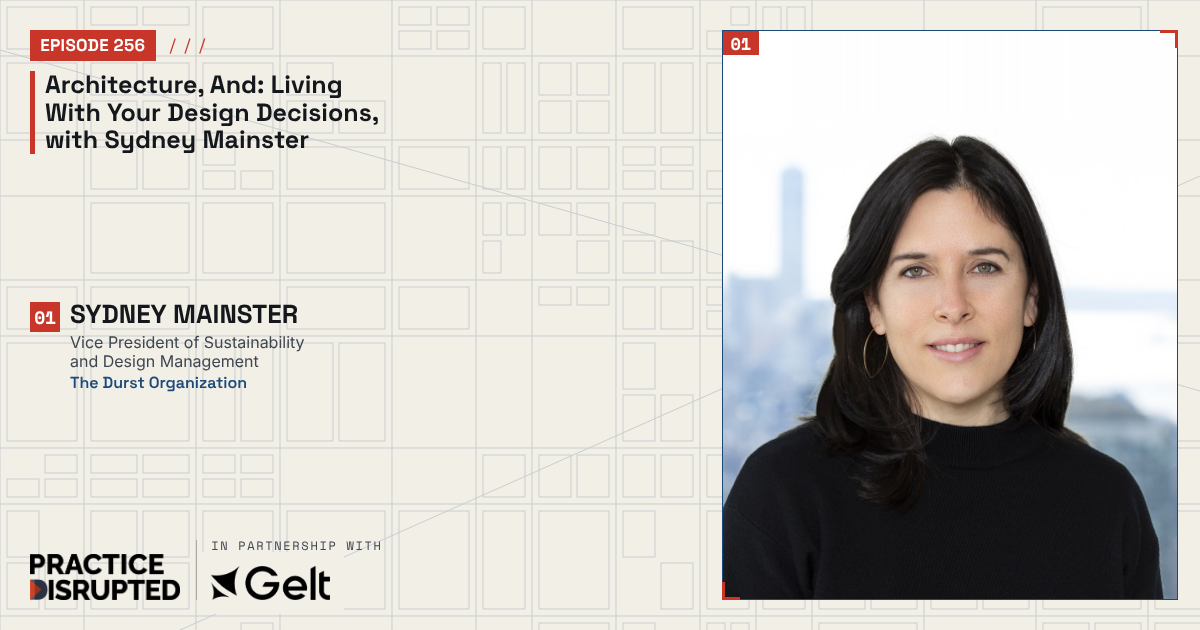 Presented in partnership with Gelt. Sydney Mainster, Vice President of Sustainability and Design Management at The Durst Organization, on leaving the studio for the owner side of the table, what an owner and operator sees in a building that a design team never does, and what the license means in a role that isn't traditional practice. listen here |
/// the signal ///
Three threads I've been following this week.
AIA published its Business of Architecture 2026 Firm Survey Report, with nearly 900 firms reporting $121.7 billion in gross billings for 2025 and 74 percent using AI in day-to-day operations. I commissioned the AI task force during my presidency, so I've wanted this number for a while. Now that it's here, I want the other one. The report counts how many firms have AI in the work. It doesn't say what any of them got for it. The figure sitting next to it, $152,000 of net billings per employee in 2025, is the one that would. Adoption is the easy number to collect. What it returned is the one nobody has published.
Stantec reported its third quarter on November 12: net revenue up 9.4 percent, backlog up 11.6 percent to $9.2 billion Canadian, and it raised its profitability targets for the year while narrowing the range on revenue growth. Read that against the survey above and you get two different markets wearing one name. The firms at the top are telling shareholders demand is strong enough to raise margin guidance. AIA's own index has backlog at firms billing under $250,000 falling from 4.9 months to 3.1 months in the second quarter. Both of those are true, and only one of them is in the room when a small firm gets told the market is soft.
ASHRAE opened public review on new addenda to Standard 90.1-2025, the commercial energy standard most commercial projects are designed to. I've spent enough time on advocacy at the local, state, and national level to know that the firms who will be drawing to these are rarely the ones in the comment file. If your office details envelopes or mechanical systems for commercial work, somebody there has read 90.1 more carefully than most of the people who will weigh in. The comment pages are at osr.ashrae.org.
Want more where this came from? I track all of it week to week, and Lab members get the full list every Friday, with sources and one line on what each item means for a practice.
more about the Lab
/// the handoff /// - something you can do on Monday
The thirty-year column
Twenty minutes with one set of drawings and nobody else.
1. Pick a project of yours that people have been using for at least a year.
2. List the five decisions on it that somebody will live with longest. The envelope, the main mechanical system, the finish in the hardest-used space, how people get in and out, and whatever gets cleaned most often.
3. Next to each one, write the role in the owner's organization that has to deal with it now. The role, not the company, and not the person who signed your contract.
4. Mark every line where you cannot name a role.
5. Pick the one that would cost the owner the most to get wrong, find out who actually holds it, and ask them one question about it.
/// up and coming ///
Business Operations for Architecture Firms: A Hands-on AI Workshop. Free, 90 minutes on Zoom, 10:00 to 11:30am Pacific. Every date below is the same workshop, so register for just one.
Eligible attendees get a free month of Claude Max (new Claude Max subscriptions only).
Friday, December 4. register here
Monday, December 7. register here
Tuesday, December 15. register here
Wednesday, December 16. register here
The full list is at evelynlee.com/speaking.
I'm booking 2027 now. If you have a date in mind, reply to this email.