Hello Reader,
Earlier this week I was in Springfield for the first time since I graduated from Drury University. I lectured to students at the Hammons School of Architecture, and it felt like a return to my roots as I join the HSA Professional Advisory Council. Now I'm in Miami for the NOMA annual conference, the first one I've attended in person after zooming in for the last two. It's been a full week, and it means I'm missing my little ones at home dearly. My daughter has been having a bit of separation anxiety lately, so the mom guilt is at an all-time high.
Both places are full of people at the start of their careers, which has me thinking about what happens to them once they're hired. Most firms don't have mentoring built in. What we have instead is a habit of throwing people into the deep end and seeing who swims. Throwing someone into the deep end has never been an effective way to teach them how to swim.
We talk about limiting risk all the time, in our contracts, our details, and our fees, and then we throw people into the deep end to train them. That's kind of an oxymoron. A firm that would never issue a set of drawings without a QA/QC review will let someone carry a client relationship alone for the first time, and then treat whoever survives it as proof the method works.
Dominique Hawkins described a different approach on this week's episode. A young designer in her office, finishing up a construction document package, asked what came next. She told him he was going to learn construction administration, and that he was going to learn it from her. He'd already told her he learned more in eight months there than in four years at his previous job. She also brings her staff into client meetings and has them listen before they say anything. Nobody in that story is treading water alone.
So here's my question. Who at your firm is in the deep end right now, and who is in the water with them?
| |
| /// the adaptability read /// |
| Where does your firm land? |
| Sixteen questions, five to seven minutes. Your result comes up on screen and tells you which of four areas to work on first. |
| take the Read |
I read every reply and I answer them, so feel free to write any time.
Keep learning and growing,
|
|
Evelyn Lee, FAIA | NOMA
Founder, Practice of Architecture
Host, Practice Disrupted & Fractional COO
|
This issue is brought to you by our partner Kestrel Labs.
Kestrel checks your Revit model against the code your jurisdiction actually adopted. Their guide, Compliance Isn't a Milestone, makes the case for checking code requirements again each time the design changes, rather than once a phase.
get the guide
/// practice disrupted ///
🎧 EP251: Letters to Ms. 1000, paving the way for Black women in architecture
|
|
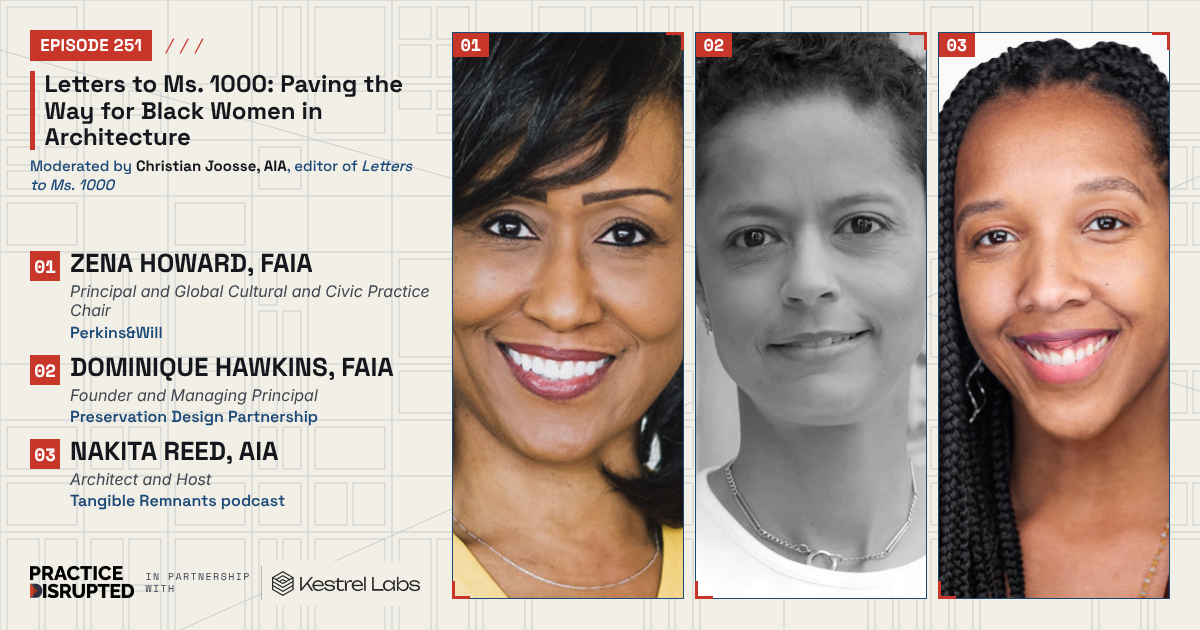
Presented in partnership with Kestrel Labs. Christian Joosse, who edited and curated Letters to Ms. 1000, moderates the first of four conversations with its contributors: Zena Howard of Perkins&Will, Dominique Hawkins of Preservation Design Partnership, and Nakita Reed. They talk about who they wrote their letters to, why an advocate is different from a mentor, and what a firm can put behind someone sitting for the exams.
|
/// the signal ///
Three threads I've been following this week.
Korb Architecture in Milwaukee announced at the end of September that it is now entirely employee-owned through an ESOP, with founder Jason Korb moving to chief executive and Kathleen Laird becoming president. The 100 percent figure is the firm's own announcement rather than an independently reported one. This is a few weeks old and I expect most of you missed it, because the ownership stories that travel are the ones where somebody from outside buys in. Those are the ones I get asked about. An owner who wants out has more than one kind of buyer, and one of them already works there.
Alper Turan told Archinect on October 9 that the way to hold onto authorship with AI in the room is to move it earlier and then slow down. He used it at the front of a project and did the interpretation, the typologies, and the final drawings himself, and he puts authorship in "that slower process" of choosing, redrawing, and rejecting. If the valuable thing is the time, attention, and decisions that went into the work, then a firm that uses AI to compress the schedule and bills the same way as before is charging for the part that got cheap.
David Burney, who ran New York City's Department of Design and Construction, wrote in Common Edge on October 6 that the city's new fast-track plan for twelve community districts will not produce housing at the volume being promised for it. Developers made little on the existing inclusionary bonus, so a larger building in a district that is already dense is not obviously worth building, and residents have little say in the process. What he wants instead is "some big sites where we can plan complete neighborhoods, not just infill housing." I hold onto this one because entitlement reform is what clients cite when they tell you a project is about to move. Faster approval is not a financed project, and the schedule you are asked to hold is built on the second one.
Want more where this came from? I track all of it week to week, and Lab members get the full list every Friday, with sources and one line on what each item means for a practice.
more about the Lab
/// the handoff /// - something you can do on Monday
Who's in the water with them
Twenty minutes this week, with your project list open.
1. Go down your active projects and mark every one where someone is doing a task for the first time: first CA, first client meeting, first fee proposal, first round of consultant coordination.
2. Next to each mark, write the name of the more experienced person working alongside them on it. If there isn't one, leave it blank.
3. Pick one blank and ask a senior person to take it, with a set time each week to go over the work together before it goes out.
4. Tell the person doing it for the first time who that is and when they'll meet.
5. Put the first review on both calendars before the end of the day.
/// up and coming ///
The next three on the calendar:
BQE webinar, workforce strategy and the future of the A/E firm, virtual, October 21, 11am Pacific and 2pm Eastern, earns one CEU. register here
AIA New Mexico, lecture, George Pearl Hall, University of New Mexico School of Architecture and Planning, Albuquerque, October 26.
Your Firm Is the Project, workshop, The Venetian, Las Vegas, November 9.
If you'll be at any of these, come find me and say hello.
The full list is at evelynlee.com/speaking.
Booking for 2027? Reply to this email and let's find a date.