Hello Reader,
The question I get on advisory calls is never phrased as a knowledge problem. It shows up as succession, or ownership transition, or what happens when a senior person retires. Underneath all three is something plainer: when the person who knows why we did it that way leaves, does any of what they knew stay behind?
Usually not. It sat in one or two heads, and the firm ran for years as though that arrangement was permanent.
Natalia Bakaeva stopped accepting that. She ran a multidisciplinary practice in Toronto, then built a memory layer so a firm's drawings, details, and past decisions stay searchable instead of walking out the door. I care less about the software than the premise underneath it: a firm's own history should be as easy to consult as the person who has been there longest, and right now it almost never is.
Architecture runs on knowledge nobody wrote down, because nobody had to. The judgment lives in proximity. You learn why a detail failed by sitting next to the person it failed on. That works right up until they aren't in the room.
I've been thinking about building something for this myself. Not a memory layer, something smaller and nosier: a bot that interviews you after every meeting and gets down what was said, and the part that went unsaid. The reason you passed on the client. The read you had on the room and never typed into a project file.
That's the debrief I used to do with teammates after a client meeting, walking through what I read in the room against what they read in the room, while they were still learning the client. That debrief is how the judgment transferred, and none of it was ever written down.
I haven't built the bot. Natalia's answer was software, mine is still an idea I keep circling, and yours can be a notebook. Name the three decisions on your current project that would vanish if you disappeared tomorrow, and write them down before you do anything else today.
What would your firm actually lose if you took a six month leave starting tomorrow, and how much of that loss is a choice you've been quietly making all along?
Keep learning and growing,
|
|
Evelyn Lee, FAIA | NOMA
Founder, Practice of Architecture
Host, Practice Disrupted & Fractional COO
|
This issue is brought to you by Gelt.
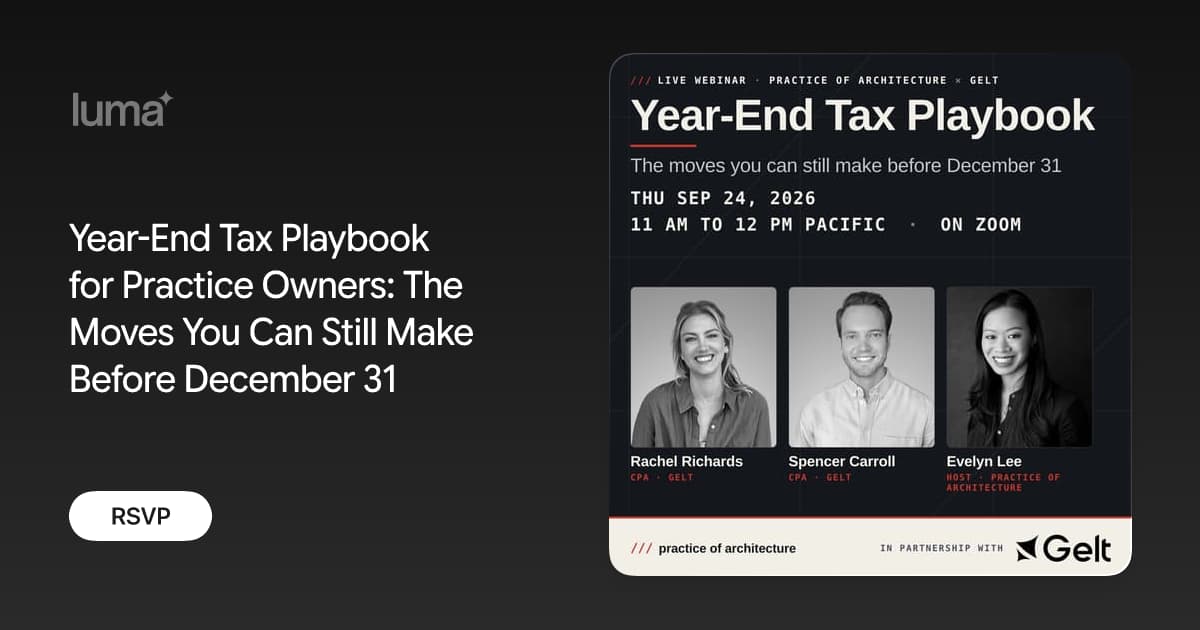
Year-End Tax Playbook, with Rachel Richards, CPA and Spencer Carroll, CPA of Gelt
Thursday, September 24, 11:00am Pacific / 2:00pm Eastern, 60 minutes on Zoom, free to attend.
I've spent enough tax seasons finding out in March what I should have decided in September to know the difference matters. Gelt's Rachel Richards, CPA, and Spencer Carroll, CPA, are walking through two real firm situations live on September 24, the kind of year-end moves that close quietly if nobody flags them in time.
/// practice disrupted ///
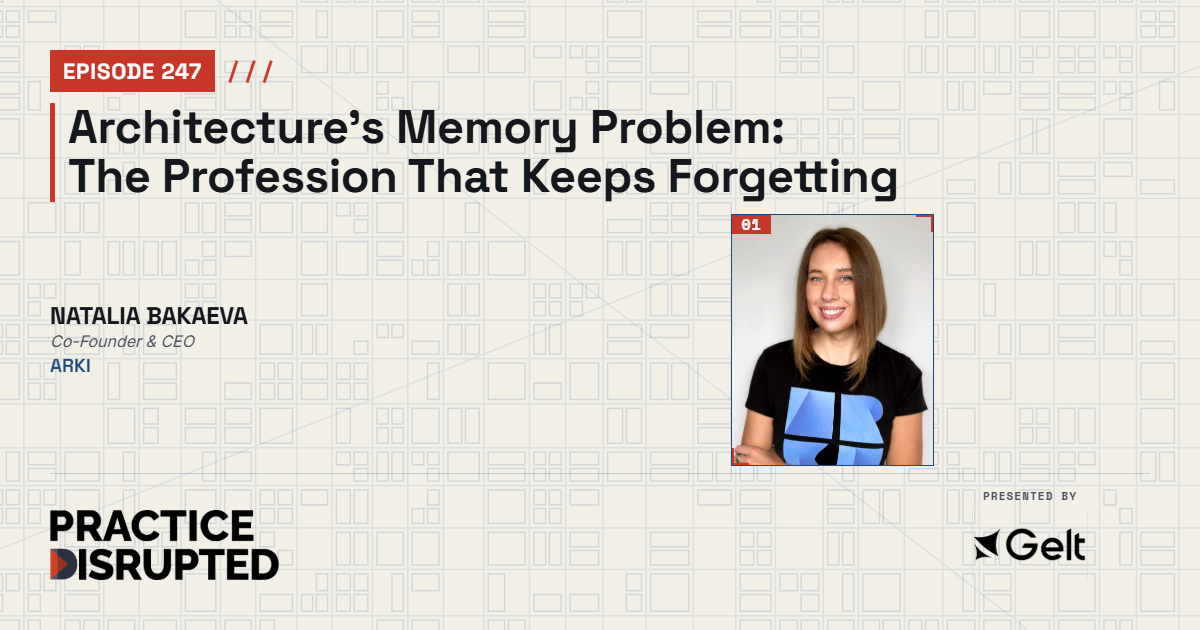
🎧 EP247: Architecture's Memory Problem, with Natalia Bakaeva
|
|
Natalia Bakaeva ran her own multidisciplinary practice in Toronto before building ARKI, an AI memory layer that makes a firm's drawings, details, and past decisions searchable instead of locked in one person's head.
|
/// the signal ///
Three threads I've been following this week.
Data center construction has added $51 billion in private spending since December 2023, while every other category of private construction has lost $120 billion combined. Net those two figures and the market is still shrinking, but you wouldn't know it from the national number alone, because one sector is carrying its whole weight. If your firm has no data center work, you are not in a slow market. You are in one that has lost $120 billion, and the topline figure is hiding that from you.
Common Edge ran a piece this week on urban designer Alexandros Washburn, who argues that AI safety might need the same kind of nourishing constraint a well-designed city gives its citizens, not just more rules stacked on top. I haven't seen that reframe from inside our own profession yet, and it puts architects back in the AI conversation as people who already know how to shape behavior through form and constraint, not as bystanders waiting on policy to catch up.
AIA read the Supreme Court's ruling on the White House ballroom project narrowly, and said so directly: the Court decided standing, not legality, so the question moves to Congressional oversight. Whatever you think of the case itself, how a professional body chooses to describe a defeat tells you what it's about to ask its members to do next.
Want more where this came from? I track all of it week to week, and Lab members get the full list every Friday, with sources and one line on what each item means for a practice.
more about the Lab
/// the handoff /// - something you can do on Monday
The three-decision audit
1. Pick the project you most recently closed out.
2. List the three decisions on it that lived entirely in your head, or one other person's, and were never written down anywhere a new hire could find them.
3. For each one, write two sentences: what you decided, and why, in language someone with zero project history could follow.
4. Put those write-ups somewhere every future project can actually reach, not a closed email thread or a Slack message that will scroll away by next month.
5. Do the same audit on your next project before you close it out, not after someone leaves.
/// up and coming ///
Gelt's Year-End Tax Playbook webinar is September 24. If you haven't grabbed a seat, register here.
The next three on the calendar:
AIA Oklahoma Conference, September 23, Enid, Oklahoma. register here
AIA Arkansas Convention Keynote, October 9, Rogers, Arkansas. register here
Hammons School of Architecture, Drury University, October 14, Springfield, Missouri.
The full list is at evelynlee.com/speaking.
Booking for 2027? Reply to this email and let's find a date.